
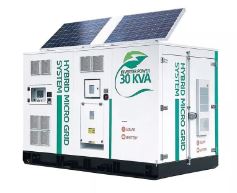
Modern power plants are highly complex systems that must operate continuously, stably, safely, and efficiently. To achieve this, a control system based on a Hybrid Computer is used, a computer that combines analog and digital processing capabilities in a single system.
A Hybrid Computer enables power plants to process continuously changing physical data (such as temperature, pressure, and speed) while simultaneously performing precise digital calculations for automated decision-making.
2. Understanding Hybrid Computers in Power Plants
In the context of power plants, a Hybrid Computer is a control and monitoring system that:
* Receives analog data from physical sensors
* Converts it into digital data
* Analyzes this data
* Controls generating equipment in real time
This system is usually integrated into a DCS (Distributed Control System) or SCADA (Supervisory Control and Data Acquisition).
3. Types of Power Plants That Use Hybrid Computers
Hybrid computers are used in various types of power plants, including:
a. Steam Power Plant (PLTU)**
* Controls steam pressure and temperature
* Regulates turbine speed
* Maintains generator stability
b. Hydroelectric Power Plant (PLTA)**
* Regulates water flow
* Controls floodgate openings
* Maintains turbine speed
c. Gas and Steam Power Plant (PLTG/PLTGU)**
* Regulates gas flow
* Controls combustion
* Maintains gas turbine efficiency
d. Solar and Wind Power Plant (PLTS)**
* Monitors light intensity or wind speed
* Regulates inverter and power output
4. Main Components of a Hybrid Computer System in a Power Plant**
a. Sensors (Analog Input)**
Sensors are used to read physical conditions:
* Temperature sensor
* Pressure sensor
* Flow sensor
* Turbine speed sensor
* Voltage and current sensors
b. Analog Processing Unit**
Functions:
* Filters noise
* Amplifies signals
* Stabilizes analog data
c. ADC (Analog to Digital Converter)**
Converts analog signals into digital data so they can be processed by a computer.
d. Digital Processing Unit (CPU/PLC)**
Performs:
* Mathematical calculations
* Data analysis
* Control logic
* Prediction and decision-making
e. DAC (Digital to Analog Converter)**
Converts digital results into analog signals to drive equipment.
f. Actuator**
Executes system commands:
* Steam valve
* Sluice gate
* Turbine governor
* Cooling system
5. How a Hybrid Computer Works in a Power Plant**
Stage 1: Data Collection**
Sensors capture physical data such as boiler temperature, steam pressure, water flow, and turbine speed.
Stage 2: Analog Processing**
Analog signals are amplified and filtered to reduce interference.
Stage 3: Data Conversion (ADC)**
Analog data is converted to digital data.
Stage 4: Digital Analysis**
The computer analyzes the data to:
* Maintain power stability
* Avoid overheating
* Optimize generator efficiency
Stage 5: Decision Making**
The system decides on an action, such as:
* Adding or reducing fuel
* Regulating water/steam flow
* Reducing generator load
Stage 6: Digital-to-Analog Conversion (DAC)**
The decision is converted into an analog signal.
Stage 7: Execution by Actuators**
The actuators carry out the command, such as opening a valve or slowing down a turbine.
6. Example of a Steam Power Plant Work Process**
1. The sensor reads the boiler temperature (analog)
2. The Hybrid Computer analyzes the temperature digitally
3. If the temperature is too high, the system reduces fuel flow
4. The steam valve is automatically controlled
5. Electrical power remains stable and safe
7. Advantages of Using a Hybrid Computer**
✅ Very fast response (real-time)
✅ High accuracy and stability
✅ Reduced risk of system failure
✅ Increased energy efficiency
✅ Supports 24/7 operation
8. Challenges and Disadvantages**
❌ High installation costs
❌ Complex system
❌ Requires expertise
9. Impact on the Electrical Power System**
* More stable electricity quality
* Reduced network disruptions
* Longer machine life
* Increased operational safety
10. Conclusion**
Hybrid Computers are a key technology in modern power generation machinery. By combining analog and digital processing, these systems are capable of controlling power plants precisely, quickly, and safely. Hybrid Computer ensures that the electricity supply remains **stable, efficient, and sustainable**, making it very important for national energy needs.